
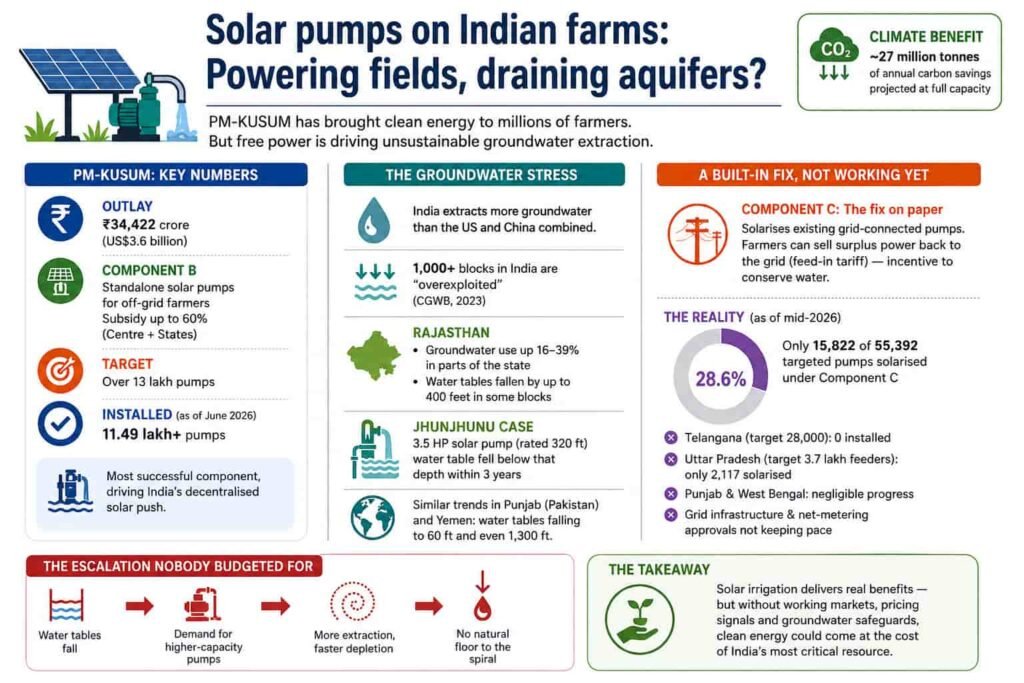
India’s Pradhan Mantri Kisan Urja Suraksha evam Utthaan Mahabhiyan (PM-KUSUM), launched in 2019 with a central outlay of ₹34,422 crore, has enabled the installation of more than 11.49 lakh solar irrigation pumps by June 2026, reducing diesel dependence, protecting farm incomes and supporting decarbonisation. However, the elimination of pumping costs is raising concerns over excessive groundwater extraction, particularly in Rajasthan, Punjab and Haryana. Research cited in the report indicates that groundwater use increased by 16–39% in parts of Rajasthan following wider solar pump adoption, with water tables falling sharply in some blocks. The scheme’s Component C, designed to encourage farmers to sell surplus solar electricity to the grid and thereby incentivise water conservation, has progressed slowly, with only 15,822 of its 55,392 targeted individual pumps solarised by mid-2026. The experience highlights the need to align renewable-energy expansion with groundwater regulation, effective grid infrastructure, appropriate pricing incentives and aquifer management to ensure that agricultural decarbonisation does not accelerate water depletion.
Source: Indoen