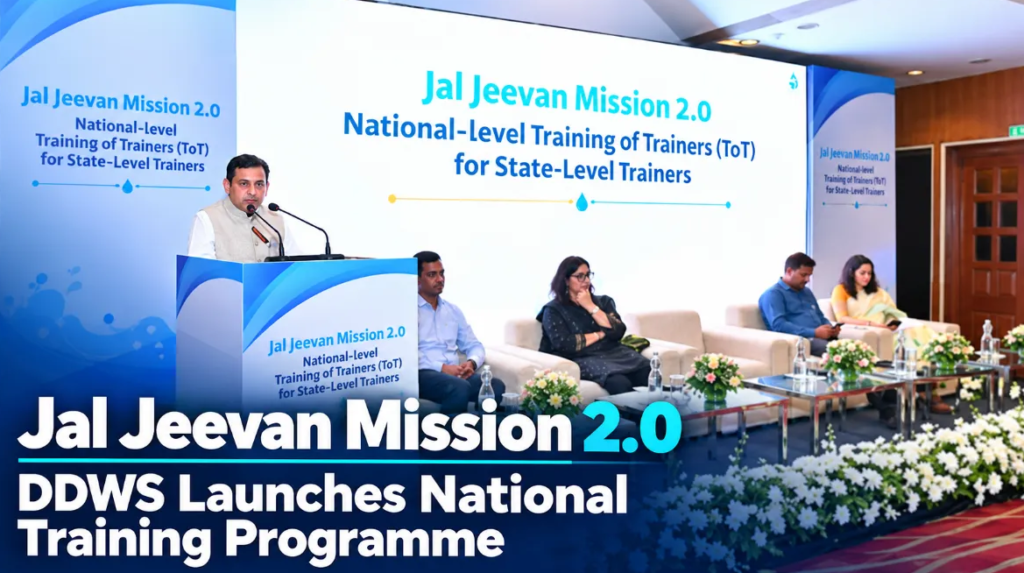
The Department of Drinking Water and Sanitation (DDWS), Ministry of Jal Shakti, organised a national-level Training of Trainers (ToT) programme under Jal Jeevan Mission (JJM) 2.0 at India Habitat Centre, New Delhi, on October 23, 2026. The programme brought together representatives from State Institutes of Rural Development (SIRDs), Public Health Engineering Departments (PHEDs), Rural Development institutions and other stakeholders to strengthen community-led management of rural drinking water services.
A major highlight was the introduction of the eight-module capacity-building package, “The Story of Panipur: A Story-Based Self-Learning Handbook on Rural Drinking Water Supply Management,” along with a Trainer’s Facilitation Manual. Using storytelling, role plays, folk communication and interactive learning, the package aims to equip Gram Panchayat representatives, Village Water and Sanitation Committees (VWSCs), Sujalam Shakti Groups and other grassroots institutions with practical knowledge of village water supply management.
Addressing the programme, Kamal Kishore Soan, Additional Secretary and Mission Director, National Jal Jeevan Mission, emphasised that long-term sustainability depends on community ownership, responsible water use and effective local institutions. He called for integrating water supply priorities, source protection and operation and maintenance requirements into Gram Panchayat Development Plans, while leveraging available financial resources. He also highlighted user-charge collection, community monitoring and institutionalising training within existing Rural Development and Panchayati Raj systems.
Swati Meena Naik, Joint Secretary, DDWS, stressed the importance of capable village institutions and technology-enabled governance through platforms such as Sujalam Bharat and layered dashboards. The broader training initiative proposes to cover nearly 54 lakh stakeholders across States and Union Territories. Representatives of UNICEF and UNOPS also shared field experiences and approaches for effective grassroots training. The programme aims to strengthen local capacity in water quality, operation and maintenance, digital governance and the development of sustainable Sujal Gaons, while encouraging women’s leadership through Sujalam Shakti Groups.
The national-level Training of Trainers marks an important step in implementing Jal Jeevan Mission 2.0’s capacity-building framework. By strengthening Panchayats and community institutions, the initiative aims to improve rural water governance, promote water conservation and ensure the long-term sustainability of drinking water services across India.
Source: Sarkaritel.com