
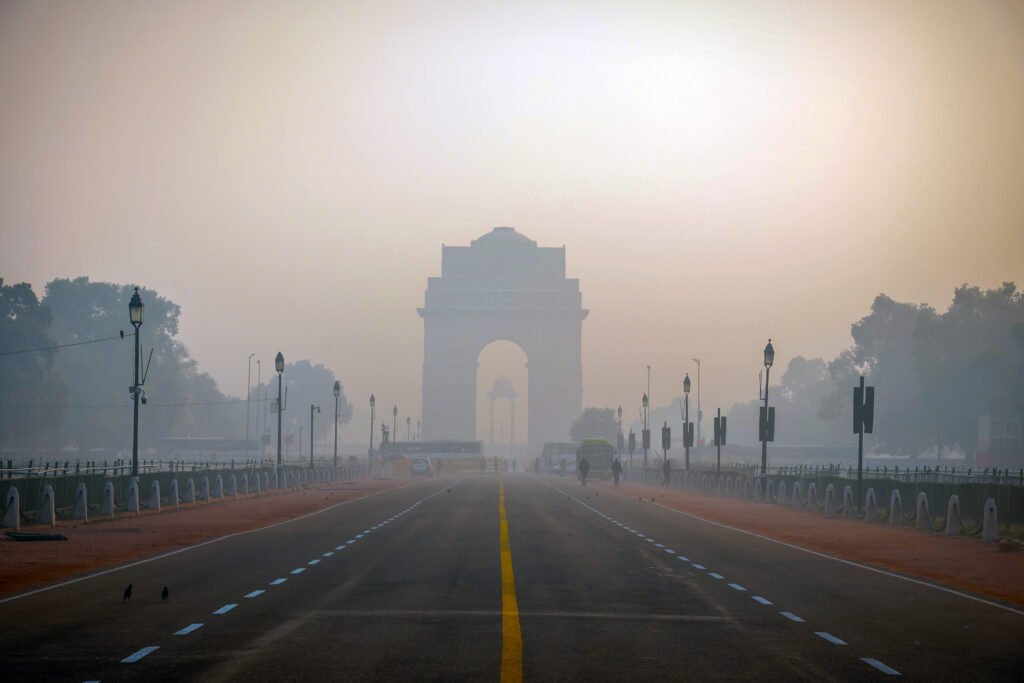
Delhi’s air quality deteriorated sharply on 5 November 2026, with the overall Air Quality Index (AQI) reaching 482 at 8:01 AM, placing the national capital in the severe category. According to Central Pollution Control Board (CPCB) data, seven monitoring stations recorded AQI levels above 400. Punjabi Bagh reported the highest reading at 446, followed by Narela (434), Rohini (431), RK Puram (416), Bawana (412), North Campus, Delhi University (408) and Patparganj (405). Several other locations, including Okhla Phase-2 and India Gate, recorded AQI levels of 399, while ITO registered 397 and Dwarka Sector 8 recorded 396. Anand Vihar and Lodhi Road reported comparatively lower readings of 293 and 268, respectively.
The deterioration has continued despite a reported decline in stubble-burning incidents compared with previous years. Union Environment Minister Bhupender Yadav stated that approximately 40% of paddy stubble had been utilised through ex-situ management. He added that the Commission for Air Quality Management (CAQM) was continuously monitoring meteorological conditions, including wind direction, wind speed and air movement, and taking necessary action based on its assessments. However, the persistence of severe pollution highlights the contribution of multiple sources and the influence of unfavourable winter weather conditions, rather than stubble burning alone.
The health impact is also becoming increasingly evident. Dr Saurabh Mittal of AIIMS Delhi reported a rise in patients experiencing exacerbations of existing respiratory conditions, alongside previously asymptomatic individuals developing cough, throat and nasal irritation, and breathlessness. Some patients require increased inhaler doses or additional medication, while the number of people seeking medical assistance is expected to rise over the coming weeks. He identified the crisis as multifactorial, involving winter meteorological conditions, vehicular emissions, construction activities and stubble burning. The situation underscores the need for coordinated, sustained action addressing all major pollution sources, alongside continuous monitoring and stronger public-health preparedness.
Source: https://timesofindia.indiatimes.com/city/delhi/delhi-pollution-worsens-aqi-hits-482-as-7-stations-record-severe-levels/articleshow/135557055.cms