
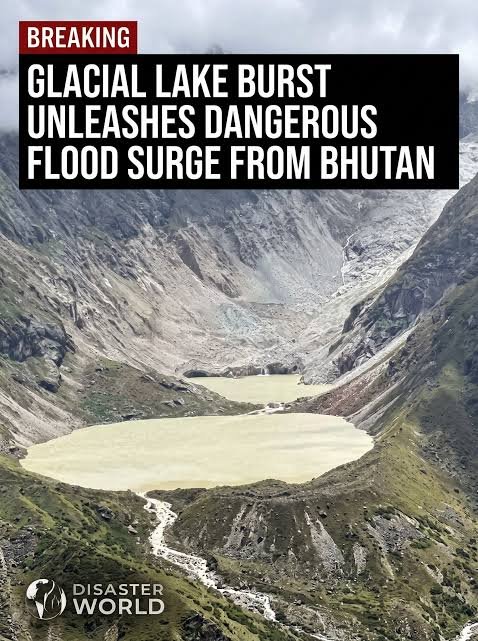
A glacial lake outburst flood (GLOF) originating from Bhutan’s Shintaphu glacial lake on 29 October 2026 has created a new temporary lake downstream, raising concerns about potential secondary flooding. Bhutan’s National Centre for Hydrology and Meteorology (NCHM) confirmed the formation of the lake at Taktsemakhang, where the Sintaphu Chhu and Lungu Chhu rivers converge, and advised residents in the Mochhu and Punatsangchhu valleys to remain vigilant and avoid riverbanks and low-lying areas. The breached lake was estimated by the International Centre for Integrated Mountain Development (ICIMOD) to contain 6–7 million cubic metres of water before the outburst. Floodwaters damaged roads, bridges and public infrastructure in Bhutan, although no casualties were reported. In India, the Central Water Commission issued a flood advisory for Assam and West Bengal. The Sankosh River rose by 1.5 metres in West Bengal before receding, while around 10,000 residents in vulnerable areas of Alipurduar and others in Assam were evacuated to shelters; no damage was reported in West Bengal. Experts warn that debris carried by GLOF waters can block river channels and create temporary lakes that may trigger further floods. With 388 GLOFs documented across the Hindu Kush Himalaya and 47 major potentially dangerous glacial lakes identified in the Koshi, Gandaki and Karnali basins, the incident underscores the need for transboundary early-warning systems, continuous glacial-lake monitoring and coordinated disaster preparedness across Himalayan river basins.
Source: The Times of India