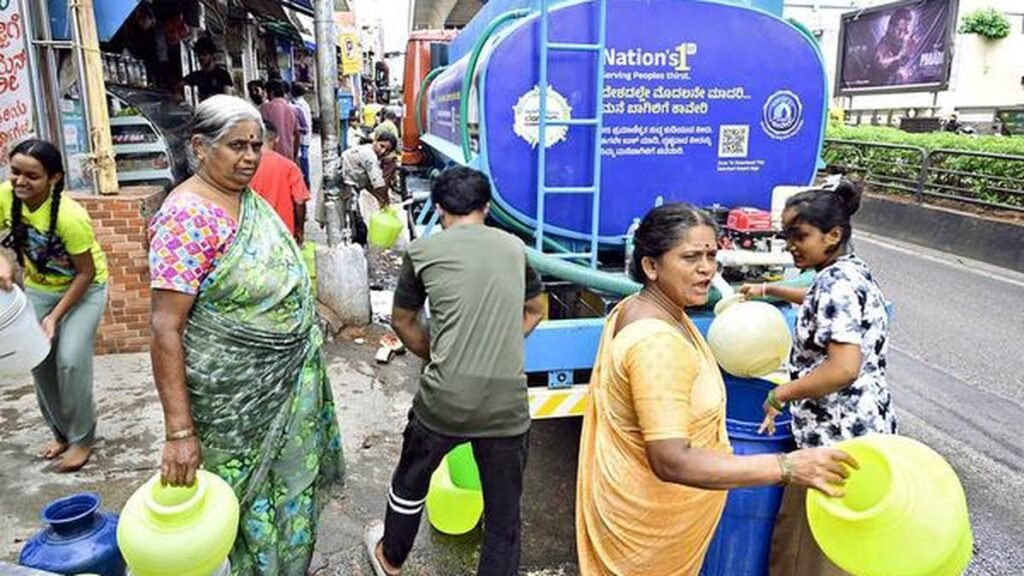
A preliminary household water audit conducted by the Water Satyagraha campaign has highlighted the growing financial burden of water scarcity on economically weaker families in Bengaluru, particularly those living in slum and peripheral areas. According to the survey, poor households spend approximately ₹3,000 per month on drinking water purchased from private tankers, exceeding the ₹2,000 monthly assistance provided to women under Karnataka’s Gruha Lakshmi scheme. Some middle-class families reportedly spend as much as ₹54,000 annually on drinking water. The city receives around 1,470 million litres per day (MLD) of Cauvery water against an estimated demand exceeding 2,100 MLD, pointing to a projected supply shortfall of more than 600 MLD. The campaign has also highlighted the absence of regulatory powers for the Bangalore Water Supply and Sewerage Board (BWSSB) to control prices charged by private tanker operators.
The audit points to deeper structural challenges involving groundwater depletion, infrastructure losses and inadequate sewage treatment. Bengaluru reportedly extracts groundwater at nearly twice its replenishment rate, with every taluk in Bengaluru Urban district categorised as over-exploited. Around 400 million litres of piped water are lost daily through leakage, theft and unbilled consumption, accounting for nearly 27% of the city’s supply. The city also generates approximately 2,120 MLD of sewage daily, of which 1,348 MLD is treated, leaving 772 MLD untreated. Concerns have also been raised over the possibility of sewage contamination where drinking water and sewage pipelines run alongside each other. Although the BWSSB reportedly tests 80–150 water samples daily, the campaign has alleged that ward-wise information on water contamination and pipeline leakage is not publicly disclosed. These concerns are particularly serious amid widespread drought conditions, with 226 of Karnataka’s 240 taluks declared drought-hit this year.
The findings underscore the need to treat access to safe drinking water as a matter of public health, social equity and constitutional rights. Citing the Supreme Court’s judgment in Subhash Kumar v. State of Bihar (1991), the campaign recalled that the right to life under Article 21 includes the right to pollution-free water and air. It has called attention to the need for stronger public accountability, transparent water-quality monitoring, improved leakage management, groundwater regulation, expanded sewage treatment and oversight of private tanker pricing. Water Satyagraha volunteers aim to survey three lakh households across Bengaluru by March 2027 and submit the findings to the Karnataka Government. The campaign also draws significance from the centenary of Dr. B.R. Ambedkar’s Mahad Satyagraha of 20 March 1927, which asserted the right of Dalits to access drinking water from a public tank, connecting the present water crisis with the continuing struggle for equitable access to this essential resource.
Source: https://www.thehindu.com/news/national/karnataka/audit-flags-3000-monthly-drinking-water-burden-on-poor-families-in-bengaluru/article71659652.ece#google_vignette