
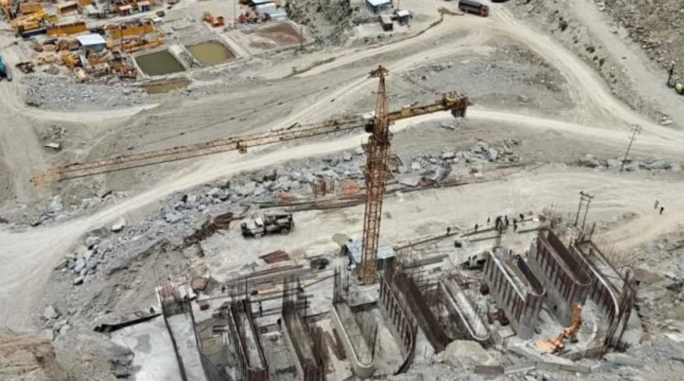
India is moving closer to commissioning two major hydropower projects on the Chenab river in Jammu and Kashmir as it accelerates development of its infrastructure on the Indus river system following the suspension of the 1960 Indus Waters Treaty (IWT) in April 2026.
The two projects are the 1,000 MW Pakal Dul and 624 MW Kiru hydropower projects. The government has initiated their commissioning processes and hopes to operationalise them in the coming months. Both projects are being implemented by Chenab Valley Power Projects Limited, a joint venture between NHPC and Jammu and Kashmir State Power Development Corporation.
Key project details:
-
Pakal Dul (1,000 MW): Located on the Marusudar, a tributary of the Chenab, in Kishtwar district. The project involves a 167-metre-high dam and an underground powerhouse comprising four 250 MW units. Its reported cost is ₹8,112 crore.
-
Kiru (624 MW): Located on the Chenab in Kishtwar. It comprises a 135-metre-high dam and four underground generating units of 156 MW each, at a reported cost of ₹4,287 crore.
-
Other projects: The 540 MW Kwar project is expected to be commissioned by 2028, while the 850 MW Ratle project has faced delays. Four additional projects on the western rivers are at various planning stages.
The article reports that India’s hydropower potential on the western rivers is estimated at 18,569 MW, of which approximately 3,500 MW has been developed so far. The government is also exploring a 10–12 km tunnel to transfer water from the Chenab to the Ravi.
On the eastern rivers, the 206 MW Shahpur Kandi project on the Ravi is expected to become operational by mid-2027. Its completion is intended to improve India’s utilisation of Ravi waters for irrigation and power generation, reducing downstream flows currently passing through the Madhopur barrage towards Pakistan.
Strategic and policy significance
The development represents a significant acceleration of India’s efforts to strengthen hydropower generation and water infrastructure in the Indus basin. However, the commissioning of these projects involves technical testing, reservoir filling and operational checks; completion of construction does not immediately translate into full electricity generation.
The IWT’s suspension also introduces legal, diplomatic and geopolitical uncertainty. The article does not establish whether or when the treaty will be renegotiated. Moreover, the treaty’s provisions distinguish between India’s permitted uses of western-river waters and Pakistan’s unrestricted use, making it important to distinguish hydropower development from unrestricted diversion or consumptive use.
Source: https://theprint.in/india/indus-treaty-on-hold-india-inching-closer-to-commissioning-two-crucial-hydro-power-projects-on-chenab/3095943/