
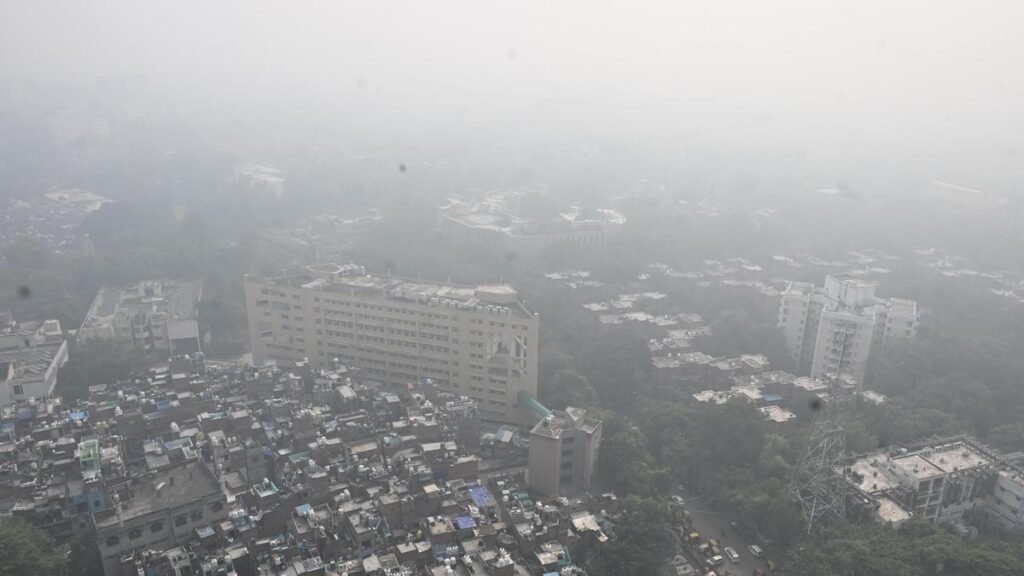
Delhi’s air quality remained in the “very poor” category for the fourth consecutive day on 5 November 2026, with several localities, including Alipur, Bawana, ITO, Dwarka and Jahangirpuri, experiencing severe pollution. Although the 24-hour average AQI stood at 369 at 4 PM, marginally lower than 377 recorded a day earlier, the Air Quality Early Warning System for Delhi forecast a deterioration to the severe category from 6 to 8 November, with conditions likely to remain between severe and very poor over the following six days. The Central Pollution Control Board (CPCB) warns that severe air pollution affects healthy people and seriously impacts individuals with existing diseases. The overall air quality is also expected to worsen during Deepavali.
Stubble burning in neighbouring states continues to contribute to Delhi’s PM2.5 pollution. According to Union Ministry of Earth Sciences data, its estimated contribution stood at 15.6% on 5 November, down from 16.28% on 4 November, but was projected to increase to 19.2% on 6 November. Delhi Environment Minister Manjinder Singh Sirsa attributed the deterioration partly to rising farm-fire incidents in Punjab, citing 584 fires recorded there on 3 November. He called for greater accountability from the Punjab government in controlling emissions at their source. Meanwhile, AAP Delhi president Saurabh Bharadwaj alleged that water was being sprayed on AQI monitoring sensors to manipulate pollution readings, claiming that the reported figures did not reflect actual PM2.5 exposure. These allegations have intensified the political dispute between the BJP and AAP over the management and reporting of air pollution.
The recurring winter pollution crisis across Delhi-NCR and the wider Indo-Gangetic Plains is driven by a combination of meteorological and human-induced factors. Lower wind speeds and falling temperatures restrict the dispersion of pollutants, while stubble burning during October and November and festive firecracker emissions compound existing pollution from vehicular activity and dust. The situation highlights the limitations of addressing individual pollution sources in isolation and reinforces the need for coordinated regional action, credible air-quality monitoring and sustained enforcement of pollution-control measures.
Source: https://www.thehindu.com/news/cities/Delhi/parts-of-delhi-continues-to-reel-under-severe-air-pollution/article71670578.ece