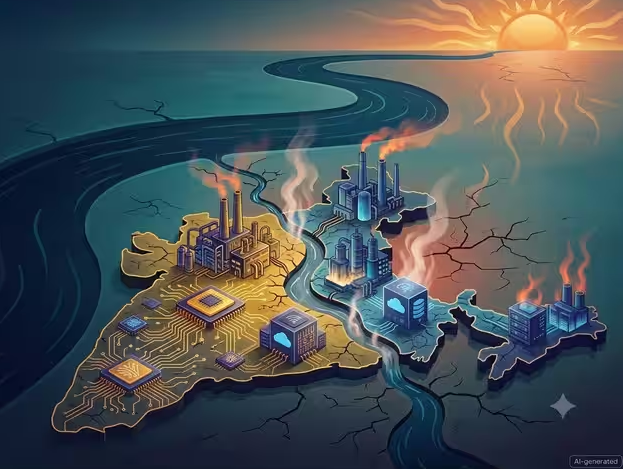
India’s ambition to become a developed nation by 2047 faces a growing challenge as water scarcity threatens the expansion of manufacturing, semiconductor fabrication, data centres and other water-intensive industries. Despite accounting for nearly 18% of the global population, India has access to only around 4% of the world’s freshwater resources. NITI Aayog had projected that water demand could reach twice the available supply by 2030, potentially resulting in a 6% loss in GDP, while industrial water requirements were estimated to rise nearly fourfold between 2005 and 2030. The Central Ground Water Board’s 2025 assessment identified 730 of 6,762 assessment units as over-exploited. Thermal power, steel, textiles, chemicals, pharmaceuticals, electronics and semiconductor manufacturing are particularly vulnerable, with water shortages already affecting industrial operations. According to industry experts, water availability, quality and supply reliability could increasingly determine where new industrial clusters are established and at what cost.
Treated municipal wastewater is emerging as a significant alternative to freshwater for industrial consumption. According to CPCB data cited in the report, urban India generates approximately 72,368 million litres of sewage per day, but only around 20,235 MLD is actually treated against an installed treatment capacity of 31,841 MLD. This underutilised resource could supply cooling water to thermal power plants, data centres and semiconductor facilities, while reducing competition between industries and urban households. CEEW estimates that treated used water could generate a market worth ₹72,000 crore by 2047 at current prices. Technologies such as ultrafiltration, reverse osmosis, closed-cycle cooling, wastewater recycling and zero-liquid-discharge systems can improve industrial water efficiency. Desalination may also support coastal industrial clusters, although its feasibility inland is constrained by conveyance costs and brine management. However, experts emphasise that technology alone cannot address the challenge; reliable water-quality monitoring, digital metering, water audits, demand forecasting and basin-level resource management are equally important.
The principal barriers to wider wastewater reuse are economic and infrastructural rather than technological. Underpriced groundwater makes recycled water less attractive, while inadequate pipelines, storage facilities and distribution networks prevent treated wastewater from reaching industrial users. Experts have therefore called for realistic, scarcity-based pricing of freshwater abstraction, competitive tariffs for treated wastewater and long-term supply agreements between urban local bodies and industrial consumers. Existing policy measures, including the 2016 Tariff Policy, AMRUT 2.0 and the National Framework on Safe Reuse of Treated Water (2022), provide a foundation, but implementation and enforcement remain critical. Gujarat’s policy mandating treated water for specified thermal plants and industries offers one example of this approach. Industrial corridors, semiconductor clusters and major investment projects should also undergo comprehensive water-balance assessments before approval, with identified sources and drought-year contingency plans. Ultimately, integrating water security into industrial planning will be essential to protect freshwater resources, strengthen urban revenue streams and ensure that India’s manufacturing ambitions remain economically and environmentally sustainable.
Source: https://economictimes.indiatimes.com/news/india/india-wants-more-factories-fabs-and-data-centres-where-will-the-water-come-from/articleshow/135485209.cms